
The Export Trap: Why Africa's Commodity Exporters Are Leaving Billions on the Table
The most important strategic decision facing many African commodity businesses is not what they produce or where they sell. It is how much of the value chain they choose to own.
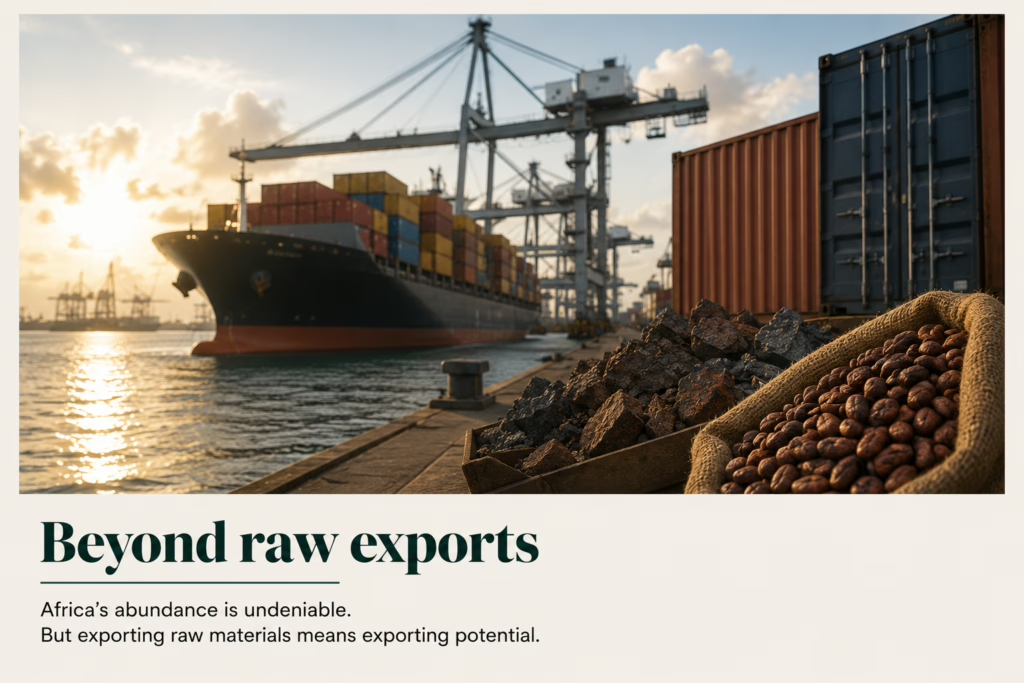
Across Africa, commodity exporters have built impressive businesses around sourcing, aggregation, production, and export. Whether the product is cocoa, sesame, copper, manganese, lithium, timber, cotton, or natural rubber, the underlying model often looks remarkably similar: raw or lightly processed materials leave the continent, while the highest-value stages of processing, manufacturing, branding, and distribution take place elsewhere.
The result is a structural imbalance in value capture.
A tonne of a commodity sold in raw form generates one level of revenue. Processed into an industrial ingredient, refined material, intermediate product, or finished good, that same tonne can generate several times more value. The difference is not simply a matter of margins. It is the difference between participating in a value chain and controlling one.
For decades, this model made economic sense. Processing technology was expensive, access to capital was limited, certification requirements were difficult to meet, and international buyers preferred sourcing from established processing hubs outside Africa. Under those conditions, exporting raw materials was often the most rational commercial decision available.
Today, those conditions are changing.
Across multiple sectors, regulatory shifts, changing capital flows, technology adoption, and evolving buyer requirements are creating new incentives for origin-based processing and manufacturing. The question is no longer whether African commodity companies can move further up the value chain. Increasingly, it is whether they can afford not to.
This is one of the recurring themes that emerges through AHC's Outlook Workshops. Regardless of sector, geography, or company size, the same strategic question continues to surface:
How much more value could be captured if the business owned the next stage of the value chain?
What follows are some of the lessons we have learned.
The structural ceiling that most exporters do not see until it is too late
Exporting commodities is not inherently a flawed business model. Many of Africa's most successful companies were built on commodity trading and export. However, the model has a structural ceiling.
When a company exports a commodity in raw or minimally processed form, its performance is heavily influenced by factors it cannot control: global price cycles, supply dynamics in competing regions, exchange rate volatility, and the bargaining power of international buyers and trading houses.
In contrast, companies operating further downstream compete on different terms. They sell specialised inputs, industrial ingredients, advanced materials, branded products, or engineered solutions. Their customers are often manufacturers rather than traders. Their pricing is influenced by quality, specifications, certifications, reliability, and technical performance, not solely by commodity indices.
These are fundamentally different businesses, even when they begin with the same raw material. The exporter participates in a market. The processor, manufacturer, or brand owner shapes one.
Three forces making the choice more urgent
For many years, moving further up the value chain was a strategic option. Increasingly, it is becoming a strategic necessity.
- Regulation is rewarding value addition
Across global markets, regulatory requirements are becoming more demanding. Traceability standards, sustainability reporting, product certification, quality assurance systems, and environmental compliance requirements are raising the bar for market participation.
The companies investing in these capabilities are often building the foundations required not only for compliance, but also for higher-value processing and manufacturing. The infrastructure required to meet tomorrow's standards increasingly overlaps with the infrastructure required to capture tomorrow's margins.
- Capital is seeking industrial platforms, not just commodity suppliers
Institutional investors, development finance institutions, sovereign investors, and strategic buyers are increasingly interested in businesses that demonstrate the ability to create value beyond extraction and export.
Companies that process, refine, manufacture, or transform commodities are often viewed differently from companies that simply move volume. They are perceived as creating jobs, strengthening supply chains, increasing resilience, and building industrial capacity. As a result, they frequently have access to broader pools of capital and partnership opportunities.
- Technology is reshaping commodity economics
Advances in manufacturing, automation, biotechnology, advanced materials, digital trade infrastructure, and artificial intelligence are changing the economics of commodity industries globally.
The businesses that remain purely commodity suppliers may find themselves under increasing pressure. Those that build differentiated products, certified materials, specialised ingredients, or technology-enabled offerings are often better positioned to defend margins and create long-term value.
What our Outlook Workshops reveal
One of the most consistent observations across AHC Outlook Workshops is that many African companies already control the hardest part of the value chain: access to the resource itself. They have supplier relationships. They understand the market. They have built operational capability. They have established customer trust. Yet when the full value chain is mapped, it often becomes clear that the largest margins are being captured elsewhere.
The challenge is rarely ambition. It is usually capability, capital, partnerships, technology, certification, or execution sequencing. The gap is often not between a good company and a great company.
It is between a company that sells a commodity and a company that creates value from it. Between a price taker and a market maker. Between participating in a value chain and owning a larger share of it.
